Not All Turmeric Is the Same Product
If you are sourcing turmeric for a golden milk blend, a curcumin supplement, or a functional food product where the active curcumin content matters, standard Andhra Pradesh or Tamil Nadu turmeric at 2-5% curcumin is not the same product as Lakadong. Lakadong turmeric from the Jaintia Hills of Meghalaya carries 7-12% curcumin — verified by HPLC, protected by Geographical Indication (GI Tag No. 741), and grown at altitude in conditions that cannot be replicated by mainstream turmeric producing states.
For a formulator, the practical implication is real: achieving a 500mg curcumin dose in a capsule requires far less Lakadong powder than standard turmeric. For a retailer building a premium turmeric product, the GI tag and the verifiable origin story are part of the product's brand equity. But buyers need to understand that “Lakadong” is increasingly a claimed attribute in Indian spice trade — and claims of Lakadong origin without verifiable supply chain documentation and HPLC lab results are common.
What Makes Lakadong Different — and Why That Matters to Buyers
Standard commercial turmeric from Andhra Pradesh and Tamil Nadu is grown at scale, with conventional agricultural inputs, optimised for high yield rather than high curcumin content. It typically returns 2-5% curcumin by HPLC. It is a perfectly good commodity spice for culinary use — appropriate for most food manufacturing applications where curcumin concentration is not a specification parameter.
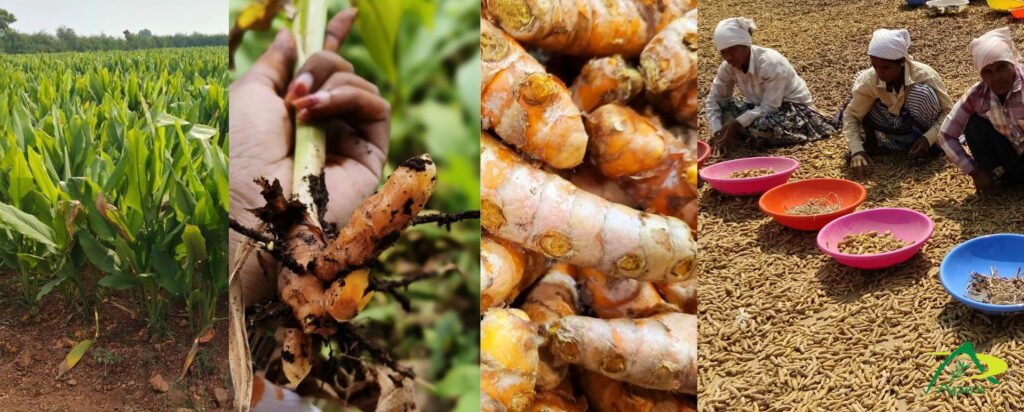
Lakadong is different at the variety level, not just the cultivation level. The Lakadong variety is a landrace cultivated in the Jaintia Hills at elevations and in soil conditions that appear to be strongly correlated with higher curcumin expression. The traditional cultivation system involves no synthetic inputs — it is organic by practice, though not all Lakadong is certified organic. The February-March harvest aligns with the Rabi growing season.
Lakadong Turmeric
- Curcumin content: 7-12% (HPLC verified)
- Origin: Jaintia Hills, Meghalaya — GI protected
- Cultivation: Traditional, no synthetic inputs (organic by practice)
- Colour: Deep golden-orange; high colour value
- Harvest: February-March (Rabi crop)
- GI Tag No. 741 — verifiable geographic protection
Standard Turmeric (AP/TN)
- Curcumin content: 2-5% (varies by variety)
- Origin: Andhra Pradesh, Tamil Nadu, Maharashtra, Telangana
- Cultivation: Conventional; synthetic fertilisers and pesticides common
- Colour: Bright yellow; good colour value for culinary uses
- Harvest: January-March
- No GI geographic protection
Curcumin Content — Lakadong vs Standard Turmeric
GI Tag No. 741 · HPLC verified
Commercial export varieties
Source: Geographical Indication Registry, Government of India (GI Tag No. 741). Curcumin content verified by HPLC.
On Curcumin and Bioavailability
How to Verify You Are Getting Real Lakadong
The demand premium for Lakadong has created a predictable problem: ordinary high-curcumin turmeric — or even blended turmeric — being sold as “Lakadong” without legitimate origin documentation. This is not hypothetical. It is a documented issue in the Indian spice trade. A buyer who relies on a supplier's verbal claim of Lakadong origin without documented verification is exposed.
Verified Lakadong sourcing requires three concurrent checks:
- GI credentials cross-check — the exporter or processor should be able to provide documentation linking the lot to the GI-registered supply chain. The GI Tag No. 741 is a protected designation; its use without supporting supply chain records is fraudulent.
- HPLC lab report showing ≥7% curcumin — from a NABL-accredited Indian laboratory, referencing the specific lot number. A result below 7% on a claimed Lakadong lot should be treated as non-conforming.
- Supply chain records showing Jaintia Hills origin — procurement records from the processing unit, or a Certificate of Origin specifying Meghalaya as the state of production. Telangana or AP on the COO rules out Lakadong origin by definition.
Practical Verification Step

GI Tag No. 741 — the Geographical Indication certificate protecting Lakadong Turmeric from the Jaintia Hills, Meghalaya.
Sourcing, Certifications, and the Organic Question
Lakadong is traditionally grown without synthetic inputs, which means it is organically farmed by practice. However, formal organic certification — NPOP (India) or USDA NOP — requires a documented audit trail going back to certified farmland. Not all Lakadong suppliers carry organic certification, and “organically grown without certification” does not satisfy EU or US organic claims on product labels.
For buyers in the EU and US organic food and supplement markets, organic certification of the supply chain is increasingly expected — particularly given the 2018/848 EU Organic Regulation requirements. If your market requires organic certification, specify this at enquiry stage. The certified-organic Lakadong supply chain is narrower than the uncertified supply chain, which affects availability and price.
Available Product Forms and Specifications
| Form | Description | Typical use | MOQ |
|---|---|---|---|
| Whole finger (dried) | Dried rhizome, uncleaned | Further processing, traditional and ethnic markets | 500 kg |
| Polished finger | Cleaned, polished whole finger | Retail display, premium spice markets | 500 kg |
| Sliced / split | Finger sliced for drying or extraction | Extract manufacturers, herbal processors | 300 kg |
| Powder (mesh 60) | Milled to 60-mesh fineness | Spice blends, food manufacturing, golden milk | 100 kg |
| Powder (mesh 100) | Fine-milled, smooth texture | Supplements, health food, premium culinary | 100 kg |
What drives price variation in Lakadong — beyond form — is the organic premium for certified lots, the verified vs claimed curcumin level (a 7% minimum lot commands a premium over a 5% lot regardless of the Lakadong label), the harvest year (current-season stock at February-March harvest vs aged stock), and the form factor (whole finger is less processed and lower cost; fine powder involves more processing steps and equipment).
FAQ: Lakadong Buyer Questions
QThe curcumin content I have seen cited for Lakadong varies wildly — 3%, 5%, even 12%. Which is correct?
The correct verified range for Lakadong from the Jaintia Hills is 7-12% curcumin (HPLC). Earlier published figures of 5-7% are outdated and reflect older testing. Claims of 3% are likely mislabelled standard turmeric. Claims of 12%+ are possible from exceptional lots but should be supported by NABL lab documentation. Always ask for a lot-specific HPLC report.
QIs Lakadong turmeric always organic?
Traditionally farmed without synthetic inputs, but not all Lakadong is formally certified organic. Certification requires audited farm records going back to certified land. If organic certification is a label requirement for your market, specify NPOP or EU/USDA NOP at enquiry stage. Certified-organic Lakadong supply is available but more limited.
QHow do I know the supply chain is actually from Jaintia Hills?
Require a Certificate of Origin specifying Meghalaya as the state of production, a NABL HPLC report showing ≥7% curcumin, and supplier documentation of procurement from the Jaintia Hills supply chain. Any one of these alone is insufficient. Together, they provide reasonable supply chain assurance.
QCan I get heavy metals testing?
Yes. A full ICP-MS heavy metals panel (Lead, Cadmium, Mercury, Arsenic) from a NABL-accredited lab is standard practice for EU and US supplement market buyers. Specify this requirement at enquiry stage so the lab panel is requested on the correct lot before dispatch.
QWhat is the difference between curcumin and curcuminoids?
Curcumin (curcumin I) is one compound; total curcuminoids includes curcumin I, demethoxycurcumin (curcumin II), and bisdemethoxycurcumin (curcumin III). Most research on turmeric health properties involves total curcuminoids. Specify which metric your formulation requires when ordering, and confirm the COA reports accordingly.