The Grade System That Confuses Most Buyers
The counterintuitive thing about makhana grades is that the higher the Suta number, the larger the bead. Most buyers assume 5 Suta is bigger than 3 Suta in some kind of quality ladder sense. The actual logic is the reverse: “Suta” originally referred to how many beads fit within a fixed ring circumference — so fewer beads fitting means each bead is larger. 7 Suta beads are the biggest. This matters because ordering the wrong grade is a common and avoidable mistake when buyers are going off word-of-mouth descriptions rather than actual specifications.
Grade directly affects three things: visual appeal (bead uniformity matters enormously for retail packaging), consumer texture experience, and price. A 7 Suta lot commands a meaningful price premium over a 5 Suta lot because it requires more raw lotus seeds to produce each kilogram of large beads — the yield of big beads per unit of raw material is simply lower. This cost difference is structural, not discretionary.
In modern processing, grading is done mechanically using calibrated vibrating sieve decks — not by hand. This distinction matters when you are evaluating suppliers: a processor who hand-sorts claims inconsistent grade accuracy. Mechanical sieving is a basic quality marker for any export-grade operation.
What Suta Actually Measures — and What It Does Not
Suta is a size classification. It tells you the diameter range of the popped bead. That is all it tells you. It says nothing about moisture content, purity, flavour, or whether the lot has been competently dried and stored. A 7 Suta lot with 12% moisture is a worse buy than a 5 Suta lot at 7% moisture for most food manufacturing applications — higher moisture accelerates rancidity and mould risk in transit and in the buyer's warehouse.
When you write a purchase specification, Suta grade is the starting point but not the complete picture. A well-written purchase order specifies grade, moisture (typically ≤8% standard, ≤6% for humid-climate destinations), purity (≥98%, meaning no broken beads, foreign matter, or skins beyond spec), and the processing method (mechanically sieved, not hand-sorted).
Grade Is Not the Same as Quality
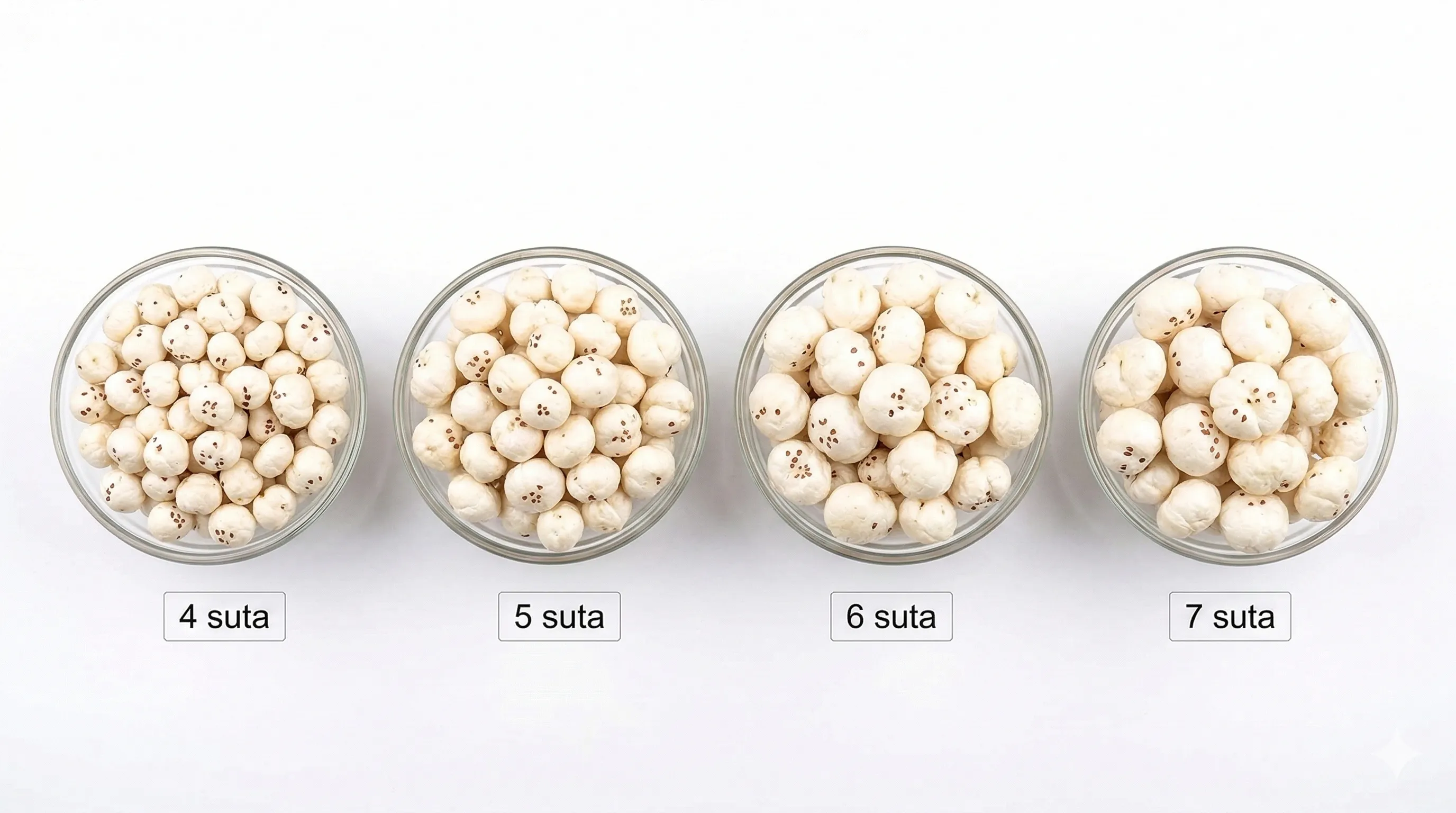
Bead Size by Suta Grade
Higher Suta = larger bead. Grades 3 and 4 Suta also exist below the export range shown above.
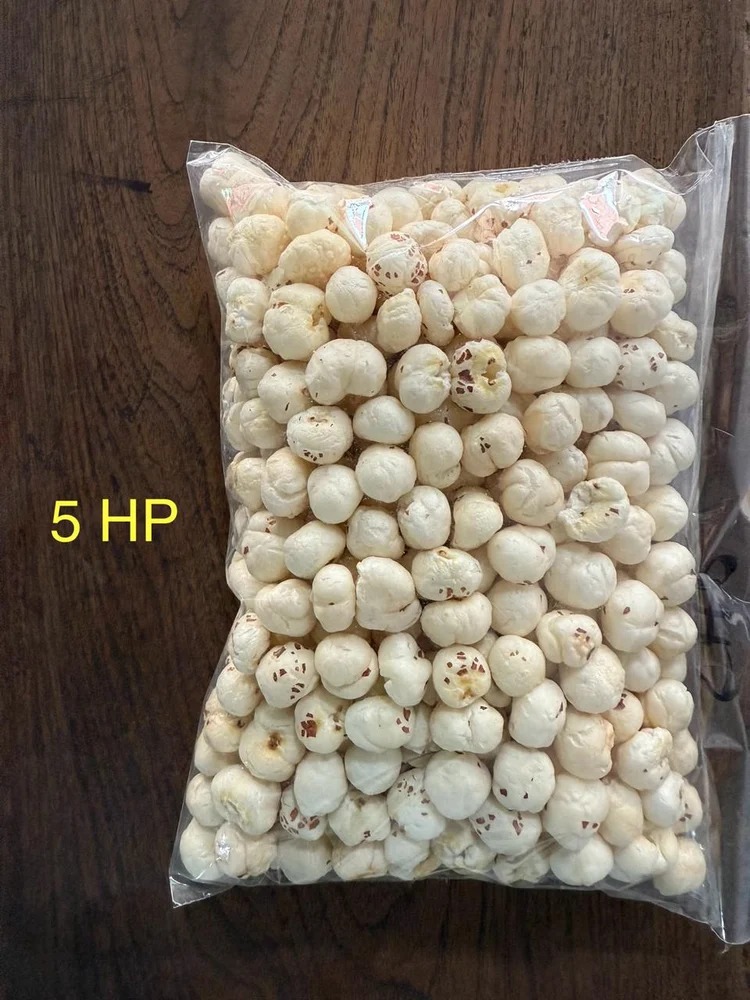
Mechanically graded makhana — the larger bead size of 7 Suta (right) is clearly visible against 5 Suta (left).
Grade Comparison by Application
| Grade | Diameter | Typical applications | Why this grade |
|---|---|---|---|
| 5 Suta | 15-18 mm | Makhana flour, trail mix ingredient, cereal bar component, budget retail packs | Most cost-efficient; size consistency less critical for processed or powdered uses |
| 6 Suta | 18-21 mm | Flavoured snack pouches, health food retail, supermarket private label, DTC e-commerce brands | Best balance of visual uniformity, texture, and price; the default grade for retail snack products |
| 7 Suta | >21 mm | Premium health food retail, gifting, food service (hotel/restaurant), high-end snack brands | Visually striking, substantial bite; justifies premium shelf price; supply is seasonal and tighter |
For flavoured variants — peri peri, Himalayan salt, turmeric-lime — buyers almost universally use 6 Suta or 7 Suta as the base, since the bead visibility in the finished pack matters to the consumer. Flavoured makhana adds up to 40% in retail value over plain equivalents, which is why the base grade selection has a compounding effect on the retail positioning you can build around the product.
5 Suta is not an inferior product — it is appropriate product for its applications. For a food manufacturer blending makhana into a granola bar or grinding it to flour, paying the 7 Suta premium serves no functional purpose. Size selection should match application requirements, not perceived prestige.
Grade Selection by Market
- Makhana flour and powder blends
- Granola and cereal bar ingredient
- Trail mix filler component
- Animal feed supplement (emerging use)
- Budget retail under ₹300/100g positioning
Largest volume in B2B ingredient channels. Not the grade to lead with in premium DTC retail.
- Flavoured snack pouches (100-200g retail)
- Health food store own-brand
- Supermarket private label programmes
- Subscription box inclusions
- Online health food platforms (US, UK, UAE)
The workhorse grade for international retail. Consistent availability year-round at commercial volumes.
- Premium natural food retail shelf placement
- Gifting and festive hamper packs
- Michelin-star and fine dining supply
- High-end DTC brands justifying >$15/100g retail
- Corporate gifting in UAE and UK markets
Seasonal availability (Oct-Feb is safest). Build buffer stock during post-harvest period.
What Actually Drives the Price Gap Between Grades
The price premium for 7 Suta over 5 Suta is not arbitrary. It reflects a real cost structure at the processor level. Large beads come from larger lotus seeds, and the proportion of raw material that yields beads above 21mm after popping is meaningfully lower than the proportion yielding 15-18mm beads. A processor handling the same batch of lotus seeds gets fewer kilograms of 7 Suta output than 5 Suta output — so each kilogram of 7 Suta represents more raw material input.
On top of the size-driven premium, several other factors shift the price spread between grades: crop year quality (a good Bihar monsoon year increases the proportion of large seeds in the harvest, slightly compressing the premium); seasonal timing (7 Suta stock is tightest in June-July pre-harvest, widening the premium during that window); and moisture specification (tighter moisture tolerances add cost at any grade).
Domestic Indian demand for premium makhana has surged — prices in Bihar have risen 150% over the past five years, driven partly by India's growing urban health food market competing directly with export buyers for the same high-grade stock. For international buyers, this means supply of 7 Suta at competitive prices requires building genuine supplier relationships and committing to volumes, not just spot purchasing.
FAQ: Grade Questions Buyers Ask
QIf I order 6 Suta, how uniform will the bead sizes actually be?
Mechanically sieved lots from reputable processors hold grade conformance of 95%+ — meaning at least 95% of beads fall within the 18-21mm band. Ask for a batch photograph and a pre-shipment sieve test result. Processors with calibrated equipment can share the sieve deck aperture specifications used.
QCan I mix grades in one container to hit a combined volume?
Yes. Different grades are packed in separately labelled bags within the container, each bag bearing the grade, lot number, and weight. Each grade still needs to meet its own MOQ (minimum 100 kg per grade for trials, 1 MT per grade for commercial orders).
QDoes roasting change the grade classification?
Roasting causes slight bead expansion — typically 1-2mm. We account for this in our pre-roast grading: raw material sieved at the appropriate pre-roast size will meet the post-roast Suta specification. This is a known parameter, not a quality variable.
QIs 7 Suta reliably available, or do I need to book in advance?
7 Suta is most reliably available October-February post-harvest. During June-September, pre-harvest supply tightens significantly and spot 7 Suta availability is limited. If your planning horizon is six months, book 7 Suta during the post-harvest window rather than trying to source it pre-harvest.
QCan I get a grade sample before committing to a commercial order?
Yes. Grade samples of 5-10 kg per grade are available at cost plus freight. The sample cost is credited against the first commercial order. We recommend sampling at least two grades side-by-side to make an informed decision.