The Two Risks European Buyers Need to Resolve First
India produces approximately 80% of the world's moringa — from Andhra Pradesh, Tamil Nadu, and Karnataka. For international buyers, this supply dominance makes India the default sourcing origin. But for EU buyers in particular, two specific issues need to be resolved before anything else: the EU Novel Food status of moringa, and the documented history of ethylene oxide contamination in Indian moringa shipments.
Moringa oleifera leaf received a positive EFSA assessment and is authorised under EU Novel Food regulation. Moringa stenopetala — a different species — received a negative EFSA assessment and is not authorised in the EU. Species verification is therefore not a formality; it is a legal requirement. EU importers must hold a Novel Food authorisation for their specific product.
Ethylene oxide (ETO) contamination in Indian herbal and spice products has been a recurring EU RASFF issue. ETO is a sterilisation agent used by some processors; its use leaves residues that exceed EU limits and trigger border rejection. The correct response is not to avoid Indian moringa — it is to source from processors who demonstrably do not apply ETO treatment, supported by lot-specific ETO residue testing from a NABL-accredited lab.
With those two issues resolved, importing moringa from India is straightforward. This guide covers product forms, specification, certifications, what drives price, and the questions real buyers ask.
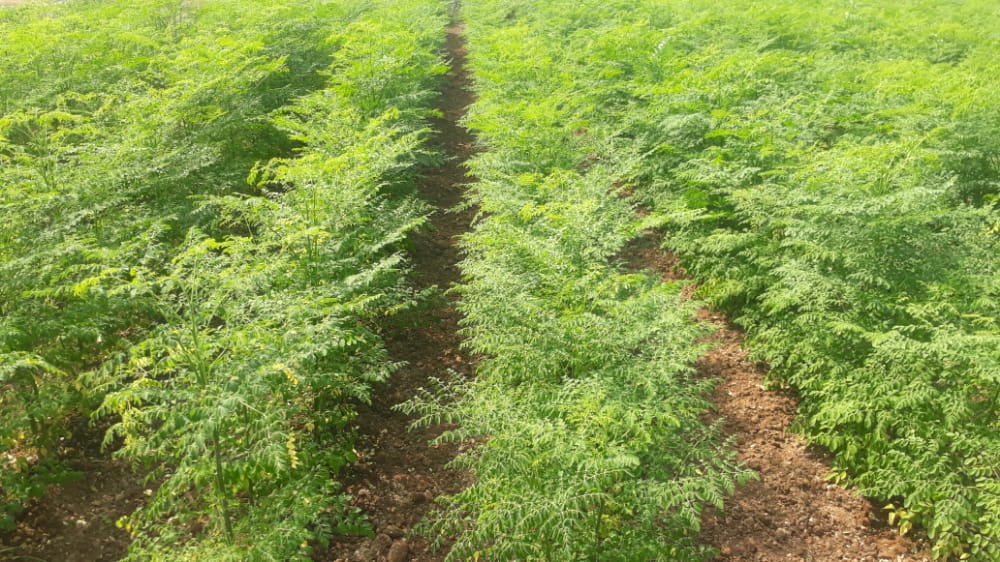
A moringa plantation in southern India. Andhra Pradesh, Tamil Nadu, and Karnataka together account for ~80% of global supply.
Image: moringa.com
Fresh Moringa oleifera leaves — harvested, shade-dried, and milled into powder. Low-temperature drying preserves chlorophyll and nutrients.
Image: orgoallnatural.com
Product Forms and Their Applications
Moringa leaf powder is the dominant commercial export form from India — it accounts for the large majority of international trade volume. Other forms exist and have specific applications, but if you are reading this guide for the first time, “moringa leaf powder, 80-100 mesh” is the reference product.
| Form | HS Code | Primary application | MOQ |
|---|---|---|---|
| Leaf powder (80-100 mesh) | 1212.21.00 | Supplements, smoothie blends, golden milk mixes, functional food ingredient | 100 kg |
| Leaf flakes / cuts (2-5mm) | 1212.21.00 | Herbal tea blends, loose-leaf tea, culinary garnish, animal feed supplement | 200 kg |
| Whole dried leaves | 1212.21.00 | Further processing, retail herb packs in natural foods market | 300 kg |
| Drumstick pods (fresh/frozen) | 0709.99 | South Asian ethnic grocery, restaurant supply — seasonal availability | 500 kg |
| Seed powder | 1212.99 | Water purification applications, cosmetic formulation | 100 kg |
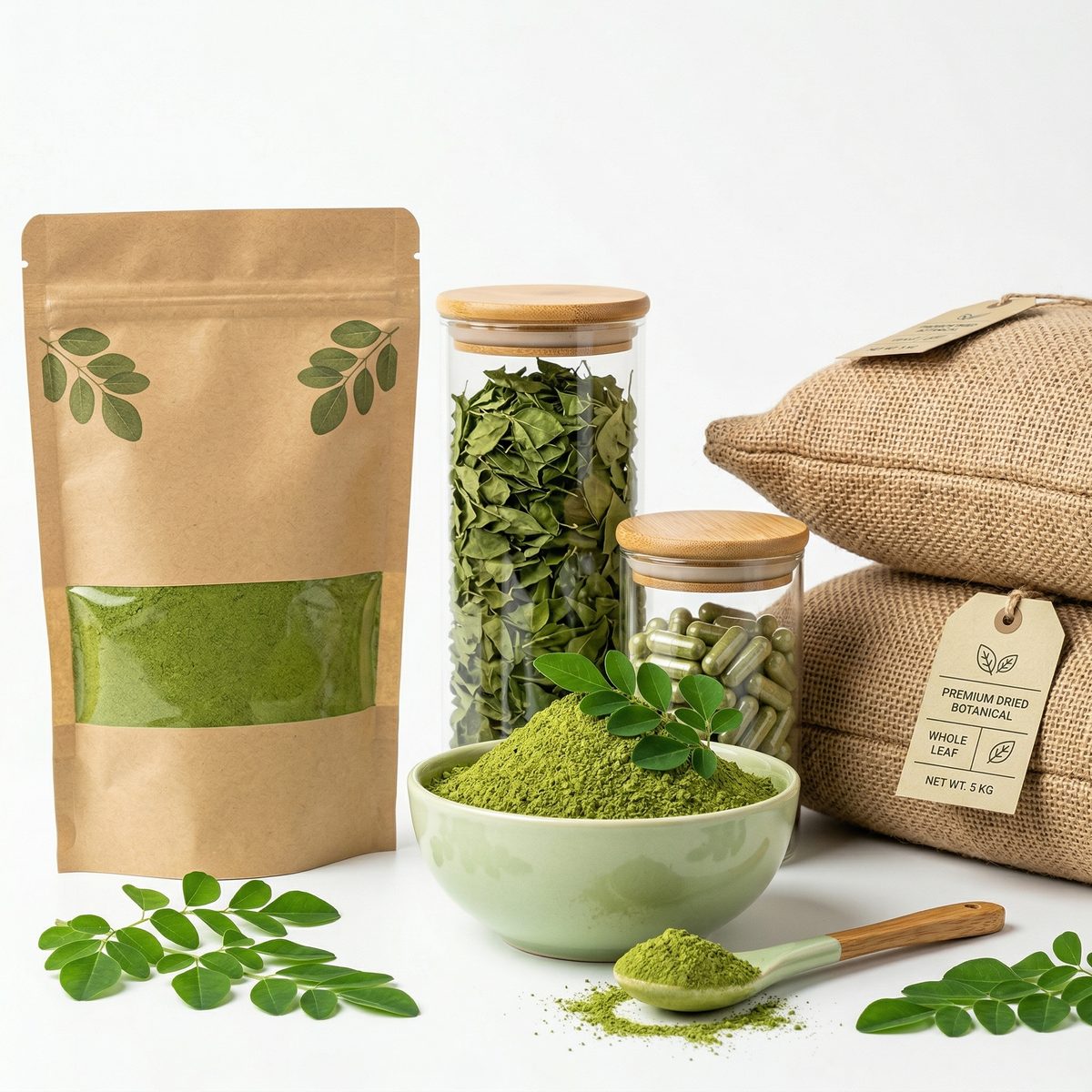
Leaf powder (80–100 mesh) — the dominant export form. Deep green = high chlorophyll = fresh, correctly dried product.
Drumstick pods (Moringa oleifera fruit) — seasonal fresh/frozen export for South Asian ethnic grocery and restaurant supply.
Image: Amazon
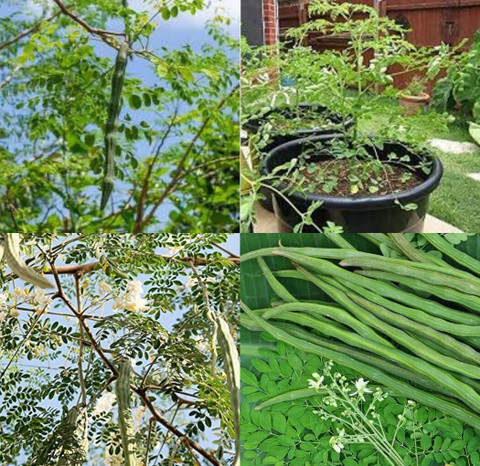
Moringa seeds (HS 1212.99) — for water purification and cosmetic formulation; different classification from leaf products.
Image: Flipkart
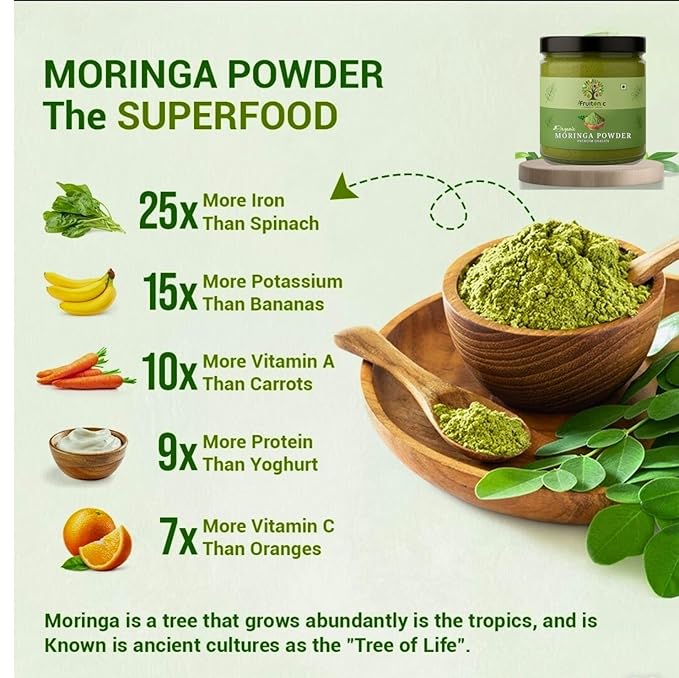
Retail-format moringa leaf powder pouches — available for private-label export alongside bulk 25kg bags.
Image: Amazon
EU and US Requirements — What You Need to Know Before Ordering
The regulatory landscape for moringa varies meaningfully by destination market. Treat this section as a pre-order checklist, not background reading.
European Union
Moringa oleifera leaf is authorised as a Novel Food under Commission Implementing Regulation (EU) 2018/1023. EU importers must hold a Novel Food authorisation to sell moringa leaf products in the EU. If you are a new EU importer of moringa, you need to obtain this authorisation — it is not the Indian exporter's responsibility. We supply the technical dossier (specifications, COA, processing information) needed to support an authorisation application.
Ethylene oxide (ETO) testing is non-negotiable for EU-bound Indian moringa. The EU limit for ETO residues is 0.02 mg/kg. Indian moringa shipments have been flagged in RASFF multiple times for ETO exceedances. Request an explicit written confirmation from your processor that ETO is not used, and include ETO residue testing in the COA panel. A NABL-accredited lab result for ETO below EU limits must accompany every EU-bound shipment.
Species verification matters legally: the COA and product specification should confirm Moringa oleifera species. Moringa stenopetala is not authorised in the EU and cannot be sold there as a food ingredient.
United States
Moringa leaf is classified as a dietary supplement ingredient by FDA and does not require pre-market approval for sale in the US supplement market. However, US importers must have a valid Foreign Supplier Verification Program (FSVP) file, which requires documented supplier qualification evidence — FSSAI licence, COA from NABL lab, and facility records. FDA Prior Notice must be filed at least 8 hours before sea arrival.
For supplement manufacturers, DSHEA-compliant identity testing (botanical ID confirmation of species) is an additional documentation requirement that must be performed at the US importer level. We can facilitate ID testing documentation from our supply chain to support this requirement.
United Kingdom (post-Brexit)
The UK has its own retained Novel Food regulation. Moringa oleifera leaf is authorised in Great Britain under the GB Novel Foods framework. EU authorisation does not automatically apply to GB imports. UK importers should confirm current FSA Novel Food status before importing. Northern Ireland follows EU rules under the Windsor Framework.
Certifications and Quality Standards
Standard COA Parameters — Leaf Powder
| Parameter | Typical Result | Specification |
|---|---|---|
| Moisture | 5-8% | ≤10%; EU buyers often require ≤8% |
| Protein (dry basis) | 27-30% | ≥25% |
| Colour (visual) | Deep, uniform green | No yellowing or browning |
| Pesticide residues (multi-residue) | Below EU MRL | Full EU MRL panel; specify US EPA or Japan if needed |
| Ethylene oxide (ETO) | Not detected | <0.02 mg/kg (EU limit) |
| Heavy metals (Lead) | <0.5 ppm | <10 ppm (FSSAI); <2 ppm EU supplement |
| Total Plate Count | <10,000 cfu/g | <100,000 cfu/g |
| Yeast and mould | <100 cfu/g | <1,000 cfu/g |
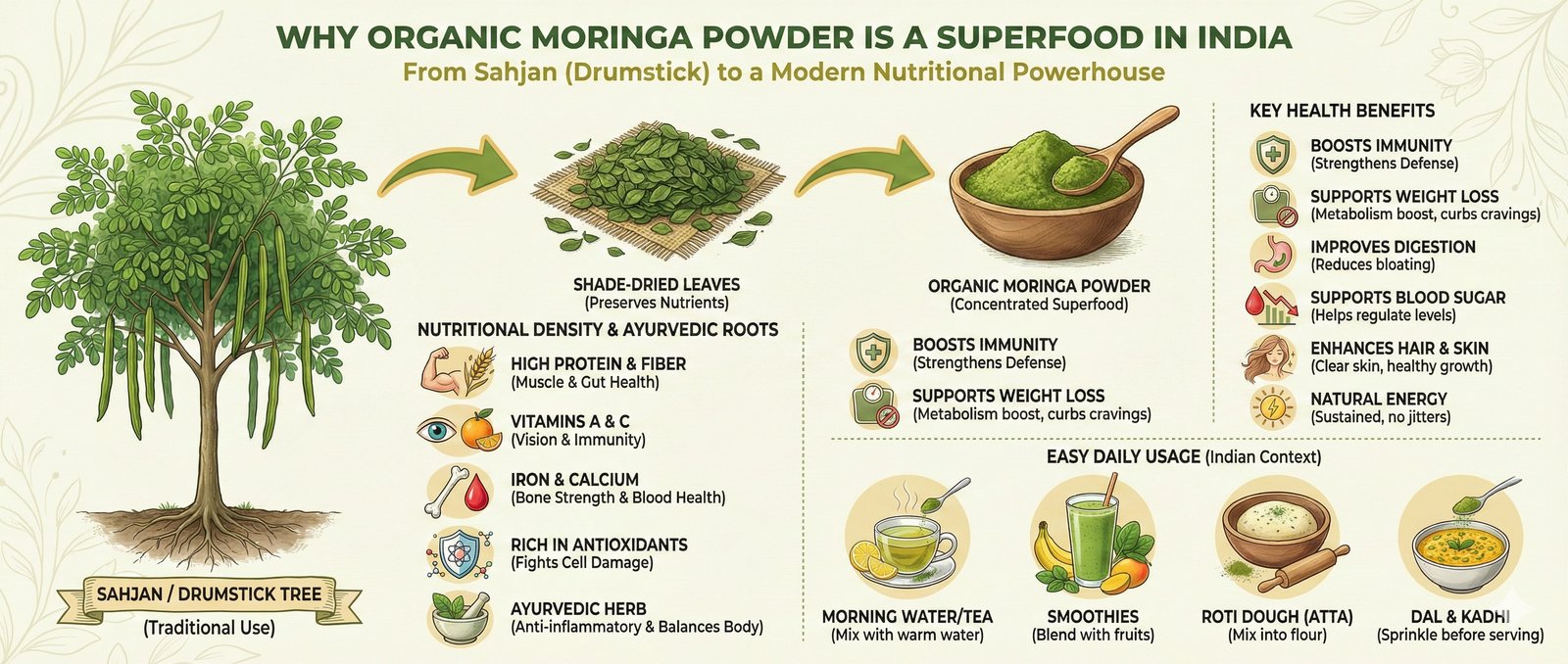
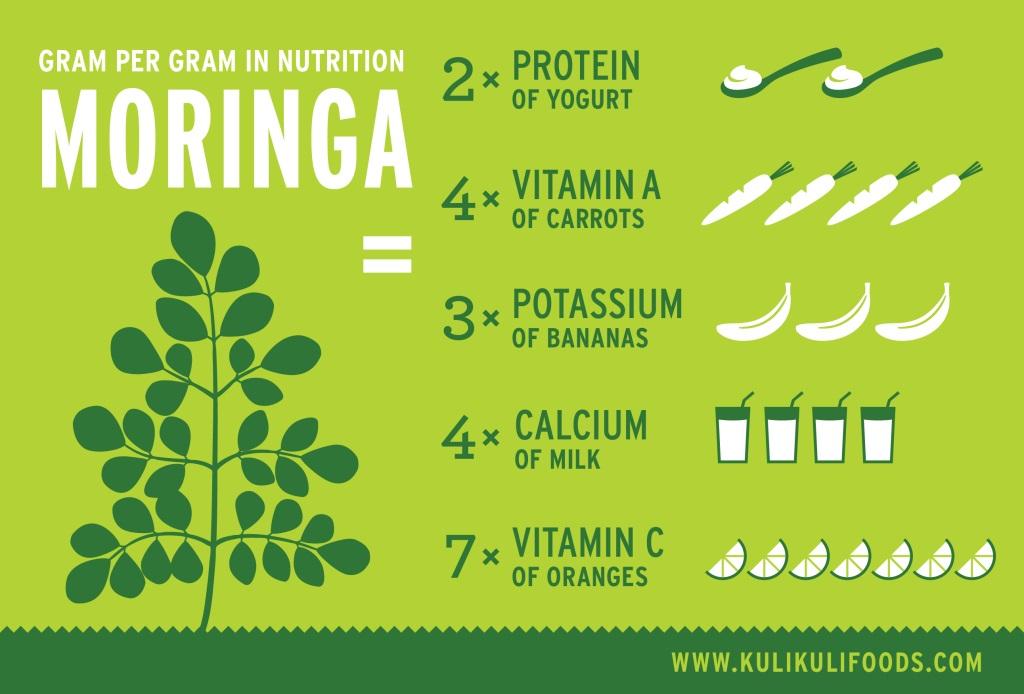
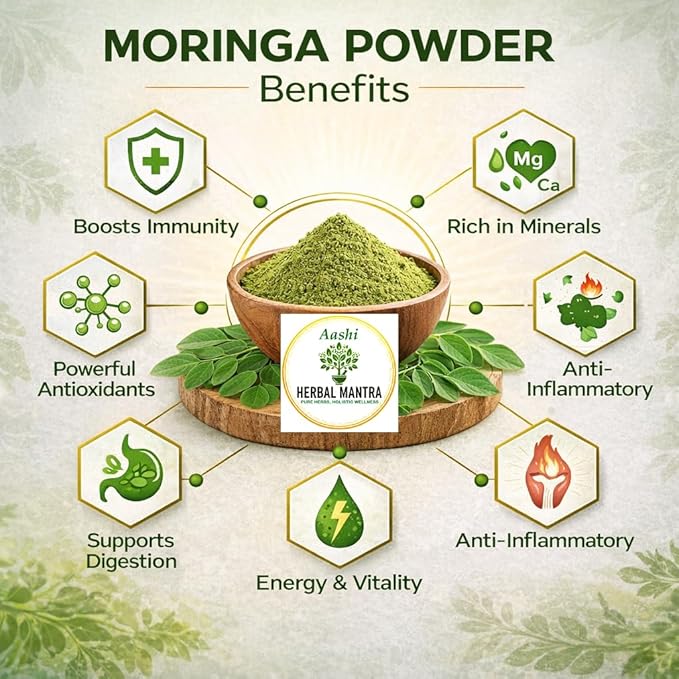
Moringa leaf powder nutrition profile — rich in protein, iron, calcium, and antioxidants, driving demand across supplement and functional food categories.
Image: Organic India / Shopify vendor
What to Watch For: Moringa-Specific Red Flags
Beyond the standard documentation red flags that apply to any Indian food export, moringa has product-specific quality and regulatory concerns that buyers should screen for.
- Yellow or off-green powder in the sample — indicates high-temperature drying, which degrades chlorophyll and nutrients; not acceptable for supplement or premium food applications
- No ETO residue test on the COA — for EU-bound shipments, this is a mandatory test parameter; absence suggests the supplier is not familiar with EU requirements
- Species not confirmed on the COA or product specification — a supplier who cannot confirm Moringa oleifera vs Moringa stenopetala species is a risk for EU importers with Novel Food obligations
- COA shows moisture above 10% — at this level, mould risk during transit is significant for a plant powder; optimal is 8-10%, and European buyers typically require ≤8%
- Protein content below 25% on dry basis — indicates poor raw material quality (old leaves, stem inclusion, excessive processing losses); ask for the COA on a fresh lot
- Supplier cannot provide a NABL COA — non-negotiable for US FSVP and EU CHED compliance; if the supplier does not work with NABL labs, they are not export-market ready
- Quote for "spray-dried" moringa that seems unusually cheap — spray drying requires dedicated equipment and typically yields a higher-value, lighter product; verify the process with the processor
The Quality Gap Is Real
FAQ: Moringa Import Questions
QDo I need a Novel Food authorisation to import moringa to the EU?
Yes, if you are placing moringa leaf products on the EU market. Moringa oleifera leaf is authorised under EU Novel Food regulation, but the authorisation is held by the importer/business placing the product on the market — not the Indian exporter. If you do not already hold or are named under an authorisation, you need to apply to the relevant EU member state authority. We provide the technical documentation package to support your application.
QHow do I verify there is no ethylene oxide in the moringa I am buying?
Request a NABL lab COA that explicitly includes an ETO residue result below the EU limit of 0.02 mg/kg. Also request written confirmation from the processor that ETO-based sterilisation is not applied in their production process. For your first shipment and periodically thereafter, commission an independent verification test from a third-party EU or US accredited lab on arrival.
QWhat colour should the moringa powder be?
Deep, uniform green — like fresh dried leaves. The green comes from chlorophyll, which degrades with heat and age. Browning or yellowing indicates the leaves were dried at too high a temperature or the powder is old. This is not just aesthetic; it correlates with lower nutrient retention. Always request a batch photograph before confirming the order.
QWhat drives the price difference between conventional and organic moringa?
Organic certification (NPOP, USDA NOP, EU Organic) requires audited farm records, no synthetic input use, and recurring annual inspection costs. The certified supply chain is narrower. Beyond certification, quality differentials — colour score, protein content, contaminant history — drive further price variation. Certified organic and high visual quality combined commands the highest prices. Conventional, lower-quality powder is at the other end of the range.
QCan I get freeze-dried moringa powder?
Freeze-dried moringa is available from select processors with the appropriate equipment. It retains higher levels of heat-sensitive nutrients and produces a lighter, more dispersible powder. Lead time is longer (30-45 days), MOQ is higher (typically 500 kg minimum), and the price premium over hot-air dried is 20-40%. For pharmaceutical or clinical nutrition applications where nutrient retention is a specification parameter, freeze-drying is worth the premium.